Hydrogen Sulfide (H2S) Sources
Hydrogen sulfide (H2S) is a hazardous gas commonly encountered in the oil & gas, petrochemical, wastewater, mining, and various industrial sectors. It is naturally generated through the decomposition of organic matter and is also released during petroleum refining, natural gas processing, and numerous manufacturing operations.
Even at relatively low concentrations, H2S can pose serious risks to personnel, industrial equipment, and the environment due to its high toxicity, corrosive nature, and flammability. Effective detection, monitoring, and treatment are therefore essential to ensure safe operations, regulatory compliance, and environmental protection.
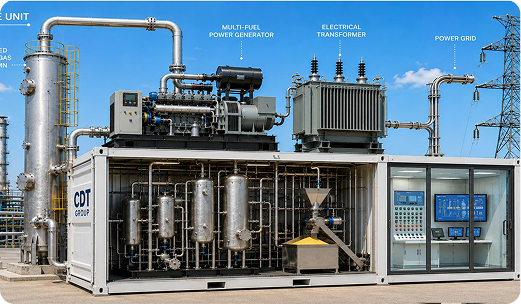
At CDT Germany, we provide advanced, modular technologies for the monitoring, gas sweetening, and treatment of H2S, enabling industries to reduce emissions, improve operational safety, recover valuable sulfur products, and enhance process efficiency. Our containerized systems are designed for reliable performance, easy deployment, and integration into existing industrial facilities.
Why is this Technology Necessary?
Environmental Necessity
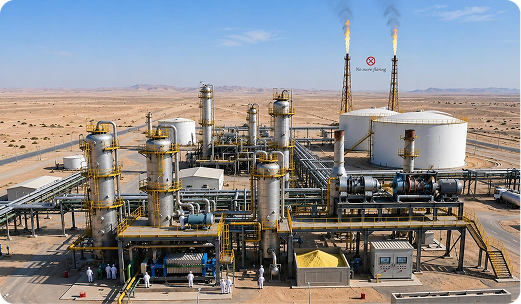
Traditional ammonia flaring and open burning practices cause serious environmental, health, and economic challenges.
1. Gas Flaring
Flaring wastes energy, reduces the reliability of the gas supply, causes regulatory violations and fines, damages natural gas reserves, and hinders sustainable development.
2. Sulfur Dioxide (SO2)
Cracking operations cause sulfur processes and systems to generate toxic sulfur dioxide gas and other harmful local air pollutants.
3. Conventional Emissions (H2S)
Conventional ammonia flaring releases H2S gas, creating serious health risks, odors, and environmental hazards, and requires additional abatement procedures.
4. Dependence on Imported Products
This technology reduces reliance on imported gas sources and replaces them with locally manufactured products and services.
5. Optimal Energy Management
Enables optimal handling of low to medium temperature energy generated from gases.
6. High Efficiency
Ensures high efficiency even with varying acid gas concentrations, exceeding the performance of traditional units.
7. Continuous Operation
Can be manufactured and installed in stages without plant shutdown. Operates easily (push-button) and with minimal maintenance (air and water cooling).
8. High Flexibility & Scalability
Highly flexible technology that can be compared with other units and easily adapted to any scale of need.
9. No Need for Power Grid Connection
No need to connect to the national electricity grid; it can be linked to other units, making it suitable for remote areas and locations without grid infrastructure.
From H2S to Treated Gas Energy and 99.9% Purity Sulfur Powder
An integrated 7-stage process from raw gas inlet to clean energy output.
Energy Output
The power generator produces clean energy (From 1 MW and above) for facility operation and export. Clean, reliable, and sustainable energy.
Key Advantages
- Stable energy output from 1 MW and above
- High efficiency and low emissions
- Treated gas production capability
- Sulfur recovery at 99.9% purity
- Fully automated operation
- Safe, reliable, and environmentally friendly